
August 25, 2026 · Little Ansar Team
When the Screen Becomes Their World: A Muslim Parent’s Guide to Social Media Addiction and Raising Children with Islam
Social media is becoming part of childhood earlier than ever. But how do we help our children navigate endless scrolling, influencers, comparison, and digital distractions without simply taking the phone away? Discover a gentle Islamic approach to raising confident, grounded children who know how to live in the digital world without losing their connection with Allah.
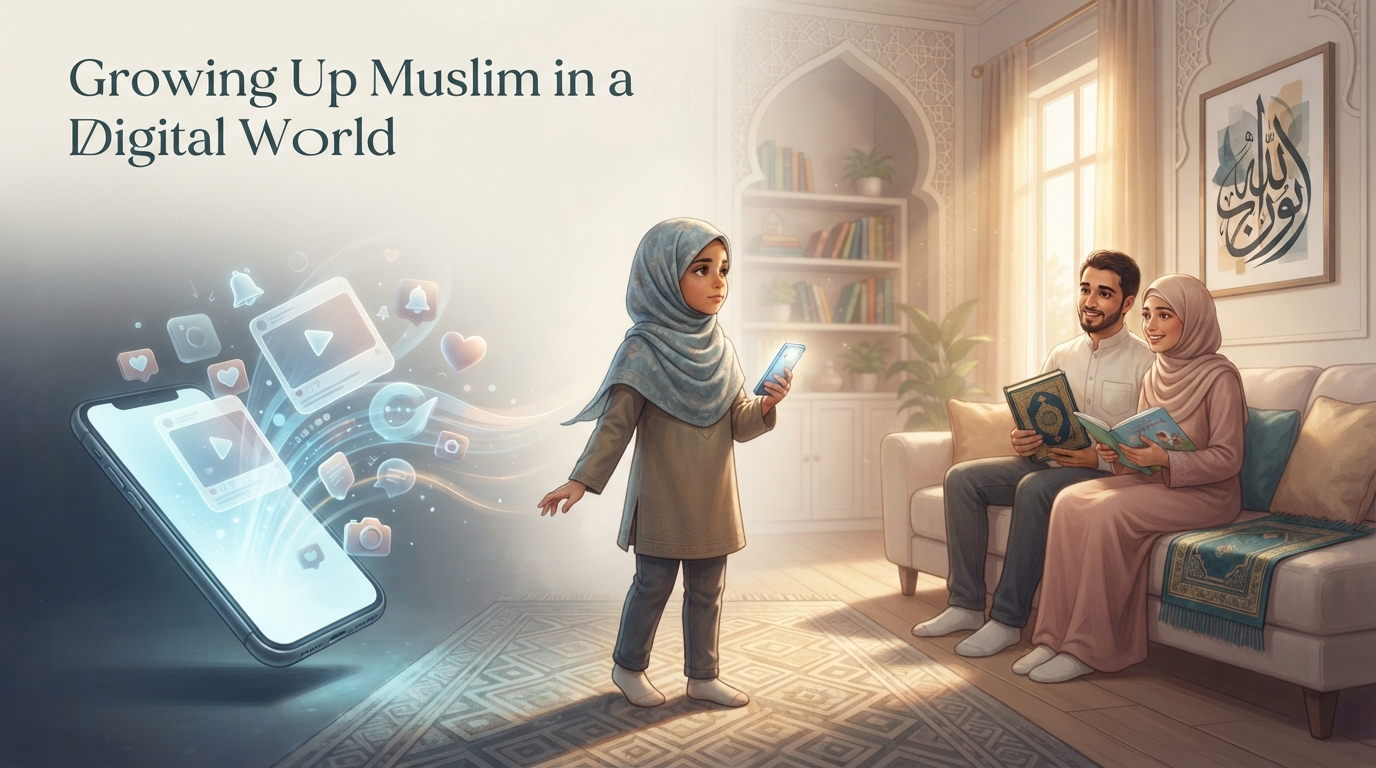
When did childhood become a scrolling experience?
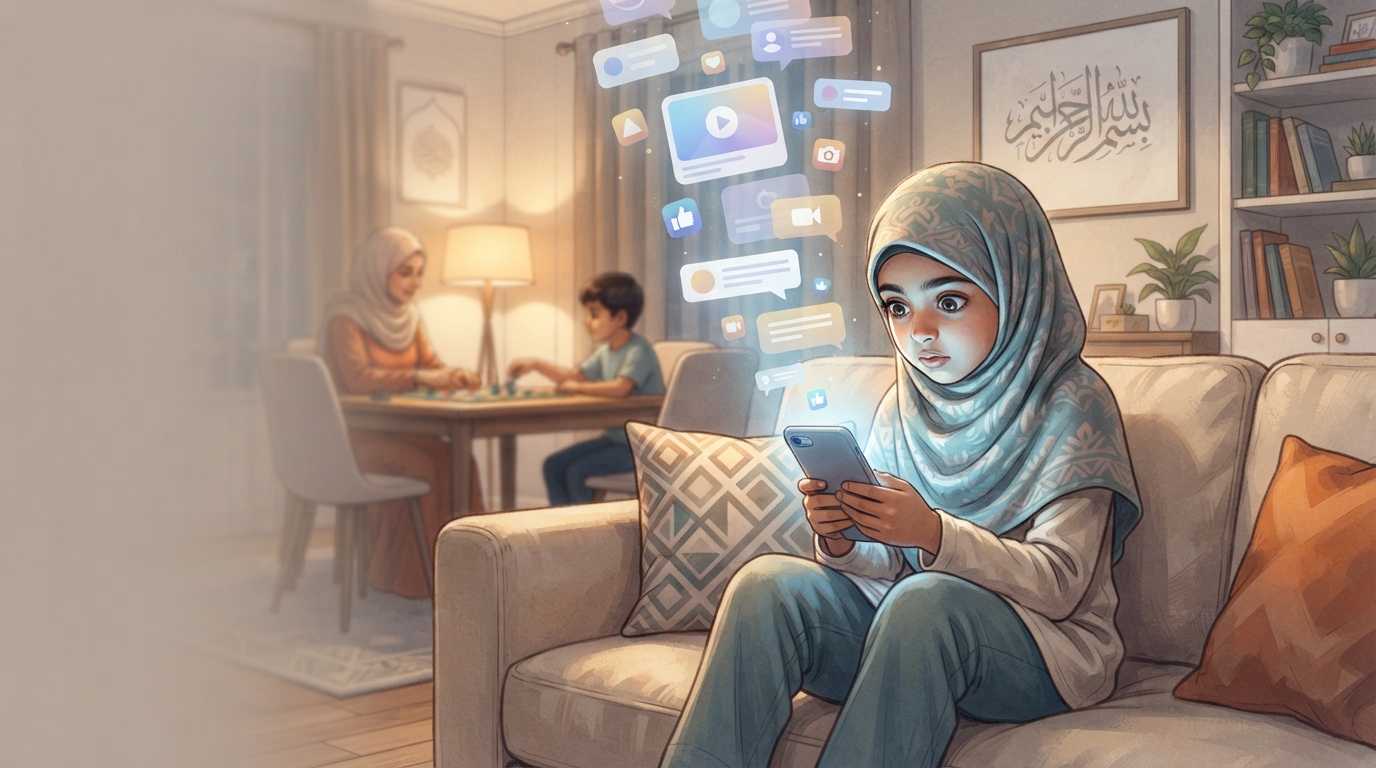
There was a time when a child could come home from school, throw their bag on the sofa, grab a snack, and disappear outside to play until someone called them home.
Today, childhood can look very different.
A child finishes school and reaches for a phone. They watch one short video. Then another. A funny clip becomes ten minutes. Ten minutes becomes an hour. Somewhere between the jokes, games, influencers, advertisements, trends, and endless scrolling, something quietly happens: the child stops being the one choosing what to watch and starts becoming the person the algorithm chooses what to show.
And this is where many Muslim parents begin to worry.
Not because every video is harmful. Not because technology itself is evil. And not because every child who uses social media is addicted.
The concern is deeper.
What happens when a child's attention becomes something that thousands of strangers compete for every day?
What happens when their idea of beauty comes from edited faces? When their definition of success comes from influencers? When their happiness depends on likes? When they compare their ordinary Tuesday with somebody else's carefully edited highlight reel?
And perhaps most importantly for Muslim parents:
What happens when the voice of the screen becomes louder than the values being taught at home?
This is not a battle that can always be won by simply saying, "Put the phone away."
Our children are growing up in a digital world. They need something better than fear of technology. They need wisdom.
They need to understand who they are, why they were created, what Islam gives them, and how to carry those values with them even when nobody is watching.
That is where Islamic parenting becomes especially important.
Social media addiction is not just about screen time
When parents hear the phrase "social media addiction," they often think about the number of hours their child spends on a phone.
And yes, time matters.
But the deeper issue is not always the clock.
Imagine a child who uses a phone for an hour to speak with family, learn something useful, or watch an educational Islamic lesson. Compare that with a child who spends thirty minutes desperately checking whether someone liked their photo, watching increasingly stimulating videos, and comparing themselves with other children.
The number on the clock doesn't tell the entire story.
The real questions are:
What is the child consuming?
Why are they reaching for the phone?
How do they feel when they cannot use it?
What is happening to their sleep, attention, family relationships, schoolwork, prayer, hobbies, and real-world friendships?
And perhaps the most important question:
Can they put it down willingly?
If a child becomes extremely upset whenever a device is removed, constantly thinks about what they are missing online, hides their usage, loses interest in activities they previously enjoyed, or repeatedly ignores responsibilities because of social media, it may be time for parents to look beyond simple screen-time rules and understand what is happening emotionally.
The goal should not be to shame the child.
The goal is to understand them.
Our children are being taught values every day
Every parent is a teacher, even when they are not sitting down to teach.
The question is not whether our children are learning values.
They are.
The question is: Who is teaching them?
A child may spend twenty minutes listening to their parents talk about being grateful, while spending three hours watching people online who constantly communicate that they need more things to be happy.
A parent may teach their daughter that her worth is not determined by appearance, while her feed continuously shows her carefully edited images of what she is supposedly expected to look like.
A father may teach his son that success requires patience and hard work, while social media repeatedly shows him people appearing to become wealthy, famous, attractive, and successful overnight.
A mother may teach her children not to compare themselves with others, while the design of many social platforms encourages comparison every few seconds.
This does not mean parents have failed.
It means the environment has changed.
And when the environment changes, parenting has to become more intentional.
Islam gives children something social media cannot
Social media can give children entertainment.
It can give them information.
It can help them communicate.
But it cannot give them a meaningful answer to the biggest questions of life.
Who am I?
Why am I here?
What makes me valuable?
What should I do when nobody is watching?
What should I do when I make a mistake?
What should I do when I am jealous of someone else?
How should I treat people who cannot give me anything in return?
What happens when life becomes difficult?
Islam gives children a framework for answering these questions.
It teaches them that their worth does not come from popularity.
It teaches them that their purpose is greater than being admired.
It teaches them that success is not measured only by money, followers, appearance, or possessions.
It teaches them that Allah sees what people do not see.
And that last idea is particularly powerful in a digital age.
Teach them that Allah sees them when nobody else does
A child may behave differently when a parent is watching.
They may put the phone down when Dad walks into the room.
They may close an inappropriate video when Mom approaches.
They may stop saying something unkind when a teacher is nearby.
But eventually, every child will have moments when nobody is watching.
That is where Islamic character becomes more important than parental surveillance.
The concept of Allah's awareness of our actions can become a source of strength rather than fear.
Our children should gradually learn:
"I don't avoid something harmful only because my parents might catch me. I avoid it because I know Allah sees me, loves me, and I want to choose what pleases Him."
This is a very different foundation from simply installing parental controls.
Parental controls can protect a child while they are young.
Taqwa helps guide them when they become independent.
Of course, children still need boundaries, supervision, age-appropriate controls, and protection. Islamic parenting does not mean giving a child unrestricted access and simply expecting perfect self-control.
It means combining protection with spiritual development.
Don't make Islam feel like another restriction
There is an important mistake parents can accidentally make.
Every time the child reaches for the phone, they say:
"Put it down."
Every time they hear music, they say:
"That's haram."
Every time they see something online, they hear:
"Don't watch that."
Every time they miss prayer because of a game or video, they hear:
"You're becoming a bad Muslim."
Eventually, the child's brain can begin connecting Islam with one word:
No.
But Islam is not simply a collection of things children are forbidden from doing.
Islam gives them something beautiful to run toward.
It gives them Allah.
It gives them Salah.
It gives them Qur'an.
It gives them dua.
It gives them stories of the Prophets.
It gives them the example of Prophet Muhammad ﷺ.
It gives them family, community, generosity, courage, forgiveness, gratitude, mercy, and purpose.
Our job is not only to make the forbidden look frightening.
Our job is to make what is good feel meaningful.
Make Salah a place they return to, not a task they escape from

One of the most powerful ways to protect a child's heart from becoming completely consumed by the digital world is to build a relationship with Salah.
But this relationship cannot always be built through shouting reminders.
Imagine a child deeply involved in a game.
"Go pray!"
They pause the game reluctantly.
They pray quickly.
Then they rush back.
The child may have completed the physical obligation, but have we helped them understand what Salah actually is?
Salah is a meeting with Allah.
It is a pause from the noise of the world.
It is five moments in the day when the child steps away from notifications, games, videos, messages, and distractions and turns toward their Creator.
That is a beautiful concept to teach.
Instead of only saying, "Your screen time is finished, now pray," sometimes say:
"Come. Let's pray together."
Let them see you put your own phone away.
Let them see that Salah is not something you demand from them while continuing to scroll yourself.
Children learn much more from what we consistently do than what we repeatedly tell them.
Your child does not need a perfect Muslim parent
This is worth saying clearly.
You do not have to become a perfect parent before you can teach your child Islam.
You may struggle with your own phone.
You may sometimes spend too much time scrolling.
You may occasionally lose patience.
You may not know the answer to every Islamic question your child asks.
That is okay.
In fact, honesty can become one of the most powerful lessons you give them.
You can say:
"You know what? I think I spend too much time on my phone too. Let's work on this together."
Suddenly, the conversation changes.
It is no longer "Parents versus children."
It becomes "Our family is learning how to use technology wisely."
That is a much healthier environment.
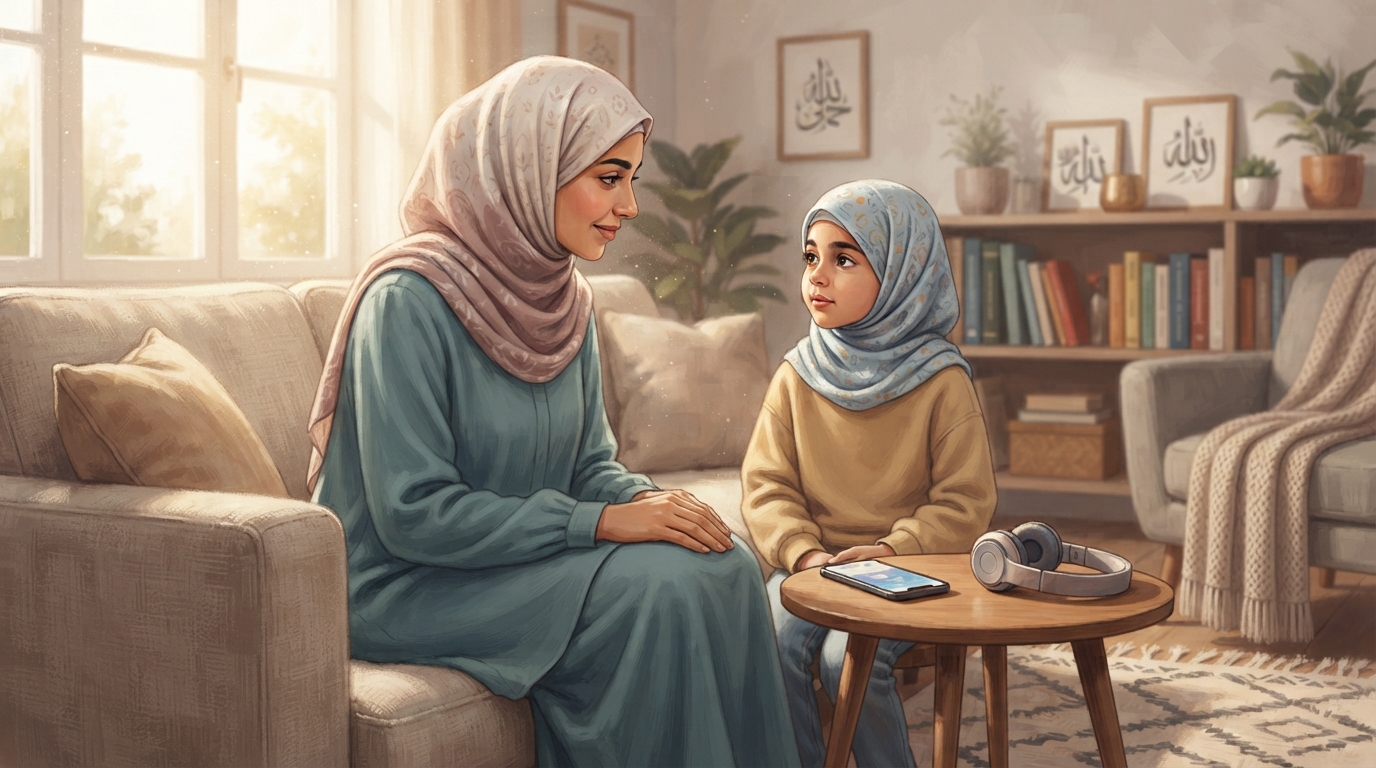
Create a home where real life is more interesting than the screen
Sometimes we tell children to stop using technology without giving them anything meaningful to replace it with.
If the alternative is:
"Put the phone away and sit there."
the phone will always win.
Children need experiences.
Take them outside.
Cook together.
Build something.
Play football.
Read stories.
Visit grandparents.
Let them help prepare food.
Go to the masjid together when appropriate.
Have family conversations.
Tell them stories from the life of the Prophet ﷺ.
Let them ask difficult questions about Islam without immediately making them feel guilty for asking.
Give them opportunities to be useful.
Let them experience the joy of giving something to someone who needs it.
A child who experiences joy, connection, curiosity, adventure, and belonging in real life has less reason to depend entirely on a screen for stimulation.
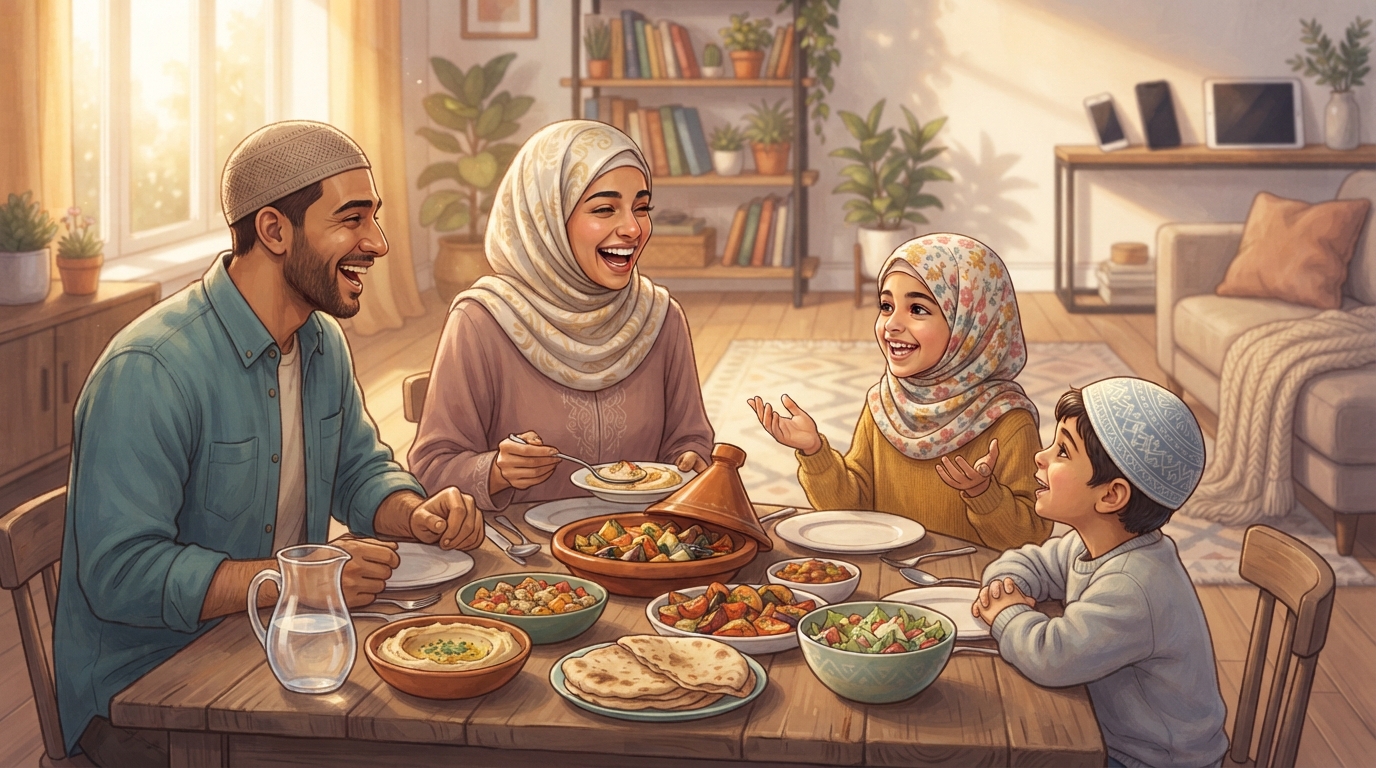
Teach children why comparison hurts

Social media can turn comparison into a daily habit.
"Why don't I look like her?"
"Why don't we have that house?"
"Why does he have so many followers?"
"Why can't I have those clothes?"
"Why is everyone having fun except me?"
Children are still developing their understanding of identity. Constant exposure to carefully selected images can make ordinary life feel inadequate.
This is where Islamic teachings about gratitude become incredibly relevant.
Teach your child to notice blessings.
Not as a way of dismissing their feelings, but as a way of training their attention.
Ask them:
"What is something Allah gave you today that made you happy?"
"Who helped you today?"
"What is something you can thank Allah for?"
"What is something you have that someone else may be praying for?"
Gratitude does not mean pretending problems don't exist.
It means teaching the heart not to become blind to its blessings.
Teach them that online popularity is not real worth
A child can receive hundreds of likes and still feel lonely.
A teenager can have thousands of followers and still feel insecure.
Someone can appear incredibly happy online while struggling privately.
This is one of the most important lessons parents can teach:
Attention is not the same thing as love.
Popularity is not the same thing as worth.
Followers are not the same thing as friends.
Virality is not the same thing as success.
And from an Islamic perspective, being seen by people is not the ultimate measure of our deeds.
A small act done sincerely for Allah can have enormous value even if nobody else knows about it.
Teach your child to appreciate hidden good deeds.
Maybe they help their sibling without telling anyone.
Maybe they give charity quietly.
Maybe they clean something at home without being asked.
Maybe they make dua for someone who doesn't know.
These are beautiful opportunities to teach children that their best moments do not need an audience.
Give them an Islamic identity before the internet gives them one
Children naturally ask:
"Who am I?"
Social media is very willing to answer that question for them.
It can tell them what clothes to wear.
What language to use.
What opinions to have.
What beauty looks like.
What success looks like.
What makes someone cool.
What makes someone embarrassing.
What they should desire.
What they should fear.
If parents do not intentionally help children develop a healthy identity, the internet will happily fill the empty space.
Islamic identity should not mean teaching children to look down on people who believe differently.
It should mean giving them confidence in their own values while teaching them kindness, justice, mercy, humility, and respect.
A Muslim child should be able to say:
"I know who I am."
"I know what I believe."
"I know why I pray."
"I know why I try to be kind."
"I know that my value does not depend on strangers online."
That kind of confidence is far more powerful than simply restricting an app.
Teach Qur'an as a relationship, not just a lesson
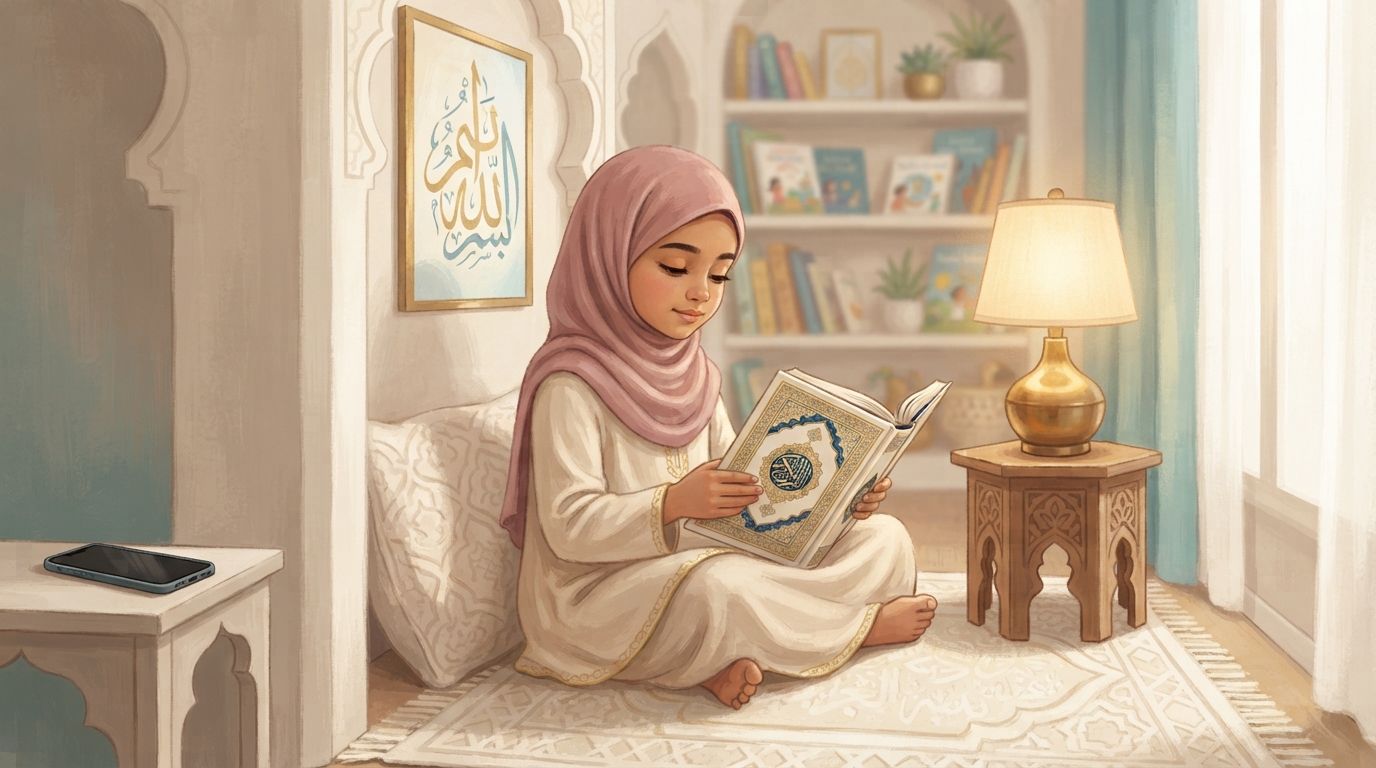
For many children, Qur'an can accidentally become another school subject.
They sit down.
They read.
They finish.
They move on.
But imagine if children began to experience Qur'an as something that speaks to their lives.
When they feel afraid, there are verses that bring comfort.
When they feel ungrateful, Qur'an teaches gratitude.
When they feel jealous, Islam teaches them how to manage the heart.
When they hurt someone, Islam teaches accountability and forgiveness.
When they feel lost, Qur'an reminds them that Allah is near.
This is why Islamic education should not only focus on memorization.
Children need stories, context, discussion, reflection, and connection.
Ask them what they think.
Ask them how a story relates to something happening at school.
Ask them what they would have done.
Ask them what lesson they think Allah wants us to learn.
When children learn to connect Islam with real life, Islam becomes part of their thinking rather than something that exists only during religious lessons.
Tell Islamic stories in a way children remember
Children have always loved stories.
Long before smartphones existed, parents and grandparents passed values through stories.
The story of Prophet Yusuf عليه السلام can open conversations about jealousy, family, patience, temptation, forgiveness, and trusting Allah.
The story of Prophet Ibrahim عليه السلام can teach courage and devotion.
The story of Prophet Musa عليه السلام can teach courage in the face of fear.
The life of Prophet Muhammad ﷺ can teach mercy, patience, honesty, courage, generosity, and compassion.
But don't rush through the story just to finish a lesson.
Stop.
Ask questions.
"How do you think he felt?"
"What would you have done?"
"Why do you think Allah helped him?"
"What can we learn from this today?"
This turns Islamic education from memorization into conversation.
And conversation creates connection.
Don't be afraid of your child's difficult questions
Eventually, a child may ask something uncomfortable.
"Why can't I do what everyone else does?"
"Why does Allah allow bad things to happen?"
"Why do I have to pray?"
"Why is this haram?"
"Why do people believe differently?"
"Why can't I have social media if my friends do?"
The easiest response is sometimes:
"Because I said so."
But "because I said so" does not build lifelong understanding.
If you don't know the answer, say:
"That's a really good question. I don't know the answer completely, so let's learn about it together."
You are not losing authority by admitting that you don't know something.
You are teaching your child that seeking knowledge is part of being Muslim.
Set family technology rules, not just child technology rules
One of the most important rules in a digital home should be:
The rules apply to everyone.
If children cannot use phones during dinner, parents shouldn't sit at the dinner table replying to messages.
If children cannot use devices in the bedroom at night, parents should consider whether the same principle should apply to them.
If you expect your child to listen when you speak, put your phone down when they speak.
Children notice hypocrisy very quickly.
You don't need to be perfect.
But you should be willing to follow the principles you teach.
Consider creating simple family rules such as:
No phones during family meals.
No recreational screens during Salah.
Devices charge outside bedrooms at night when age-appropriate.
Parents know which apps younger children are using.
New social media accounts are discussed with parents.
Children can tell parents if they see something frightening, sexual, violent, or confusing without immediately fearing punishment.
There are regular screen-free family activities.
The purpose is not to create a prison.
The purpose is to create healthy boundaries.
Make it safe for your child to tell you what they see online
This may be one of the most important rules of all.
Tell your child:
"If you ever see something online that scares you, confuses you, or makes you uncomfortable, you can always come to me. You will not be in trouble for telling me."
Children sometimes hide harmful online experiences because they are afraid their parents will take the phone away.
That fear can make dangerous situations much worse.
Your child should know that you would rather hear an uncomfortable truth than have them deal with it alone.
Build that trust before you need it.
What should parents do when the child is already addicted?
If your child is already spending excessive amounts of time on social media, don't assume that taking the phone away overnight will automatically solve everything.
First, understand the reason behind the behavior.
Are they bored?
Lonely?
Anxious?
Trying to fit in?
Avoiding school problems?
Looking for validation?
Using social media because they feel disconnected from their family?
Sometimes the screen is not the root problem.
It is the place where the child is escaping from the root problem.
Start with conversation.
Then establish reasonable boundaries.
Reduce access gradually when appropriate.
Replace screen time with meaningful activities.
Improve sleep routines.
Create screen-free periods.
Make family interaction enjoyable.
And most importantly, stay consistent.
If the behavior is severe or is seriously affecting a child's wellbeing, school, sleep, relationships, or daily functioning, parents should consider speaking with an appropriately qualified child or mental-health professional.
There is no shame in asking for help.
Don't turn every conversation into a lecture
Sometimes the best Islamic parenting happens in the smallest moments.
You're driving together.
Your child sees something online.
They ask a question.
You talk for five minutes.
That's it.
No twenty-minute lecture.
No angry speech.
No dramatic punishment.
Just a conversation.
Over hundreds of these small conversations, children slowly build a worldview.
They learn what kindness means.
They learn why honesty matters.
They learn why Muslims pray.
They learn how to deal with jealousy.
They learn what modesty means.
They learn why we don't need everyone to approve of us.
They learn that Allah is not merely a word they hear at Sunday school or madrasa.
Allah is part of how they understand life.
A simple weekly digital-and-Islam routine
Families don't need complicated systems.
Try creating a simple rhythm.
One evening each week can be a family Islamic story night.
Choose one story from the Qur'an or Seerah.
Read or listen together.
Then ask everyone one question.
Another evening can be a screen-free family night.
Play a board game, cook together, go outside, visit family, or simply sit and talk.
Once a week, let children choose an Islamic topic they want to learn about.
Maybe they want to know about Jannah.
Maybe they want to learn about a Prophet.
Maybe they want to know why Muslims fast.
Maybe they have a difficult question.
Let curiosity lead sometimes.
And every day, create small moments around Salah, gratitude, dua, kindness, and Qur'an.
Consistency matters more than perfection.

Help children understand that technology is a tool
The goal is not to raise children who hate technology.
We need children who know how to use technology without being controlled by it.
A phone is a tool.
A tablet is a tool.
The internet is a tool.
Social media is a tool.
Tools should serve us.
They should not quietly become the thing that controls our attention, emotions, relationships, and priorities.
Teach your child to ask:
"Why am I opening this app?"
"What am I looking for?"
"How do I feel after using it?"
"Did I choose this, or did the algorithm choose it for me?"
"Is this helping me or wasting my time?"
"Would I be comfortable if my parents saw what I was watching?"
"Would I be comfortable if this became part of my character?"
These questions create self-awareness.
And self-awareness is much more powerful than a timer notification.
Raise children who know how to put the phone down
One day, your child will leave your home.
You won't know every website they visit.
You won't know every person they talk to.
You won't be able to check every notification.
You won't be able to control every environment they enter.
That day is coming whether we are ready for it or not.
So our goal cannot simply be:
"How do I control my child's screen?"
The deeper question is:
"How do I raise a child who can control themselves?"
That takes time.
It takes boundaries.
It takes example.
It takes Islamic knowledge.
It takes trust.
It takes conversations.
It takes dua.
And it takes a home where children feel loved enough to ask for help.
The phone is not the enemy
It is tempting to blame the phone.
But the phone is only a tool.
The deeper challenge is attention.
Our children are growing up in an economy where attention has enormous value. Companies design products to keep people watching, clicking, returning, and engaging.
Parents therefore have an important responsibility: to teach children how to protect something incredibly precious.
Their attention.
Because whatever repeatedly captures a child's attention eventually influences what they think about.
What they think about influences what they value.
What they value influences what they pursue.
And what they repeatedly pursue shapes who they become.
This is why Islamic parenting in the digital age matters so much.

We don't need to raise children who fear the world
We need to raise children who can walk through the world without losing themselves.
We don't want children who are terrified of every website, every stranger, every new technology, and every different idea.
We want children who are confident enough to say no.
Wise enough to question what they see.
Kind enough not to mock others.
Strong enough not to follow every trend.
Humble enough to admit when they are wrong.
Curious enough to seek knowledge.
And connected enough to Allah that their identity does not depend on the approval of strangers.
That is a much bigger goal than reducing screen time.
Teach Islam before the internet teaches them who they are
Our children will encounter the internet.
They will see people with different beliefs.
They will encounter opinions we agree with and opinions we strongly disagree with.
They will encounter beautiful content and disturbing content.
They will encounter people who inspire them and people who manipulate them.
We cannot completely remove the world from them.
But we can give them a foundation before they enter it.
Teach them who Allah is.
Teach them why we worship Him.
Teach them the Qur'an.
Teach them the character of the Prophet Muhammad ﷺ.
Teach them mercy.
Teach them honesty.
Teach them modesty.
Teach them courage.
Teach them gratitude.
Teach them how to apologize.
Teach them how to forgive.
Teach them how to disagree respectfully.
Teach them that their worth is not measured in likes.
Teach them that their face does not need to look like an influencer's face.
Teach them that wealth does not define success.
Teach them that popularity is temporary.
Teach them that Allah knows their hidden deeds.
And most importantly, teach them that Islam is not simply something they inherited from their parents.
It is a beautiful way of understanding who they are and how they should live.
A final reminder for parents
One day, your child may not remember how many times you told them to put the phone away.
They may not remember every screen-time rule.
They may not remember every lecture.
But they will remember the feeling of your home.
They will remember whether they could ask you questions.
They will remember whether you listened.
They will remember whether Salah felt like a burden or a beautiful part of family life.
They will remember whether Islam was presented as a list of punishments or as a source of meaning, mercy, purpose, and hope.
They will remember whether you put your own phone down when they needed you.
And perhaps most importantly, they will remember whether you showed them what it looks like to love Allah in everyday life.
We cannot give our children a world without social media.
But we can give them something stronger than a world without social media.
We can give them roots.
So when the world becomes noisy, they know where they belong.
When everyone tells them who they should become, they know who they are.
When comparison makes them feel small, they remember their worth.
When temptation appears on a screen, they know how to walk away.
And when they eventually stand on their own, we pray that the lessons we planted in childhood continue to guide them.
Raising Muslim children in the digital age
At Little Ansar, we believe Islamic learning should not feel disconnected from a child's real life.
Children are growing up in a world of smartphones, videos, games, social media, and constant information. They need Islamic education that speaks to that world while keeping their hearts connected to Allah.
The goal isn't to make childhood smaller.
The goal is to make it meaningful.
Because our children deserve more than endless scrolling.
They deserve stories that inspire them.
Knowledge that stays with them.
Values that guide them.
And a relationship with Islam that grows with them.
May Allah protect our children, guide their hearts, make them among those who love Him, and help us as parents raise them with wisdom, patience, and beautiful character. Ameen.
- parenting
- islamic-parenting
- social-media-addiction
- children
- screen-time
- muslim-children
- quran
- salah
- islamic-character
- digital-parenting